






For most Wisconsin residential moves, a local moving company delivers better value, more flexible scheduling, and stronger accountability than a national chain. Local movers know the streets, the seasons, and the neighborhoods. National chains bring scale and infrastructure that can help with cross-country relocations. The right choice depends on your move type, distance, and priorities.
Key Takeaways
- Local movers offer personalized service, area expertise, and competitive pricing for residential and apartment moves within Wisconsin
- National chains are better suited for multi-state corporate relocations or coast-to-coast moves requiring complex logistics
- A 2025 survey by This Old House found that local moves average around $1,489, while long-distance moves average $3,129
- According to the National Business Association, 68% of money spent at local businesses stays within the community, compared to just 43% at large chain operations
What’s the Real Difference Between Local Moving Company vs National Chain?
Understanding how each type of company operates helps you make a smarter decision before you ever request a quote.
How Local Movers Operate
A local moving company typically serves a defined region, such as Green Bay, Appleton, De Pere, or the Fox Valley corridor. These companies are owner-operated, community-rooted, and built on word-of-mouth reputation. You are more likely to speak directly with the person who manages your move, and crew members often have years of experience navigating the same neighborhoods.
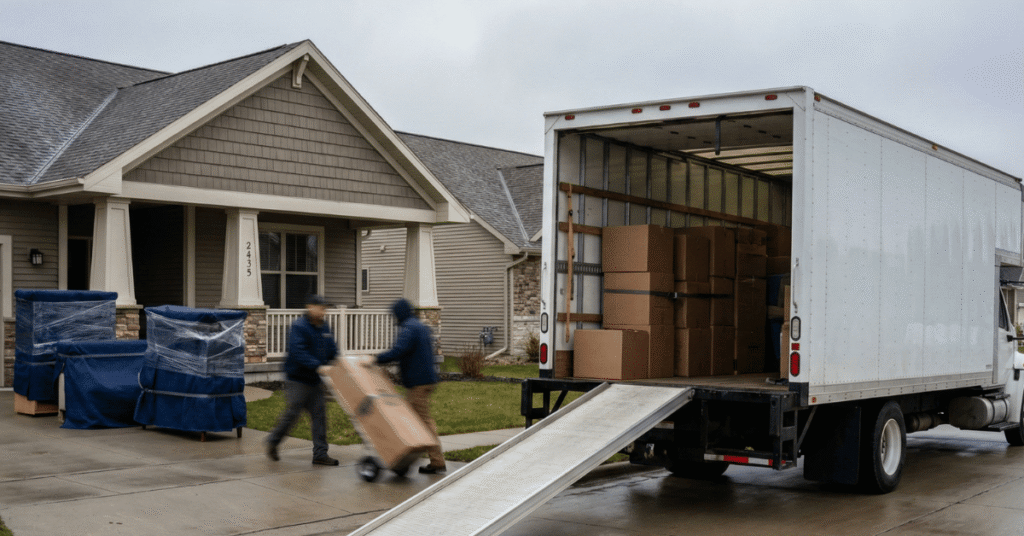
Local movers Wisconsin families rely on tend to charge by the hour, with rates averaging $80 to $100 per hour for a two-person crew. Services commonly include loading, unloading, furniture protection, and basic equipment like dollies, ramps, and moving blankets.
How National Chains Are Structured
National moving companies operate across state lines with large fleets, centralized call centers, and standardized processes. They handle high volumes of moves and often offer bundled services that include packing, storage, and vehicle transport.
However, some national companies act as brokers and subcontract your move to a third-party carrier. The FMCSA’s Operation Protect Your Move uncovered more than 1,000 violations during its 2023 enforcement operations, many tied to subcontracted moves and consumer complaints about hostage goods and inflated charges. That does not mean every national mover operates this way, but it is a risk worth understanding.
Local vs. National Movers: Quick Comparison
| Category | Local Movers | National Chains |
| Best For | Residential, apartment, and regional moves within Wisconsin | Cross-country and multi-state corporate relocations |
| Area Knowledge | Deep familiarity with local streets, parking rules, and building access | Limited; crews may be unfamiliar with your neighborhood |
| Communication | Direct contact with the owner or manager | Routed through centralized call centers |
| Scheduling | Flexible; easier to adjust dates or add stops | Rigid; peak-season slots fill fast |
| Accountability | Reputation depends on every move; word-of-mouth driven | Individual job has less impact on national brand |
| Crew Consistency | The team you hire is usually the team that shows up | May subcontract to a third-party carrier |
| Pricing Transparency | Hourly rates with in-home or virtual estimates | Flat-rate or weight-based; watch for hidden surcharges |
| Community Impact | 68% of revenue stays in the local economy | 43% of revenue stays in the local economy |
| Insurance/Resources | Adequate for most local moves; verify coverage | Often broader coverage options for long-distance hauls |
| Personalization | High; services tailored to your specific needs | Standardized processes across all locations |
Why Do Wisconsin Moves Favor Local Moving Companies?
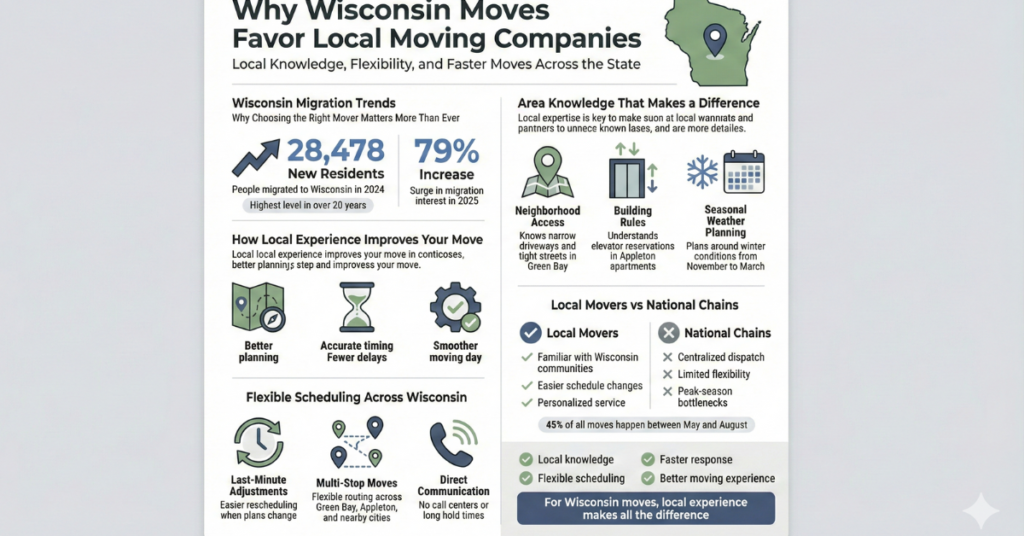
Wisconsin is experiencing a major shift in population movement. The Wisconsin Policy Forum reported that 28,478 people migrated to the state during the 2024 census period, marking the highest level in at least 20 years. Meanwhile, MoveBuddha’s 2025 trends report found that Wisconsin saw a 79% surge in migration interest compared to the previous year.
With more people moving into and within the state, choosing the right mover matters more than ever.
Area Knowledge That Makes a Difference
A local moving company in Wisconsin understands things that national dispatchers simply cannot. They know which Green Bay neighborhoods have narrow driveways, which Appleton apartment buildings require elevator reservations, and how seasonal weather affects moving timelines from November through March.
That kind of familiarity translates into faster load times, fewer surprises, and a smoother overall experience. If you are exploring communities in the area, our local guides for Wisconsin families and our comparison of living in Appleton vs. Green Bay are great places to start.
Flexible Scheduling for Green Bay, Appleton, and Beyond
Local movers are typically more willing to accommodate last-minute changes, adjusted timelines, or multi-stop routes. If your closing date shifts or your lease start changes, a locally owned company can usually adapt without penalties or long hold times with a call center.
National chains juggle thousands of moves across dozens of states. That volume can make rescheduling or customizing your move difficult, especially during peak season from May through August, when 45% of all moves take place.
When Does Hiring a National Moving Company Make More Sense?
A balanced comparison means being honest about where national chains excel. There are scenarios where their infrastructure genuinely serves you better.
Multi-State Corporate Relocations
If your employer is relocating your household across the country as part of a corporate move, a national company with established interstate logistics may be the better fit. These companies have resources to coordinate vehicle shipping, temporary storage, and delivery windows across multiple time zones.
Coast-to-Coast Moves With Complex Logistics
For moves spanning 1,000+ miles with oversized or specialty items, national carriers often have more truck capacity and routing infrastructure. Long-distance moves can cost $2,700 to $10,000 or more, so the investment warrants a company experienced in that type of haul.
If you are deciding whether your move requires professional help at all, our guide on when to call professional movers in Green Bay can help you figure that out.
How Do Costs Compare Between Local and National Movers?
Cost is often the deciding factor, and for Wisconsin moves under 100 miles, local companies consistently offer more competitive pricing.
| Factor | Local Movers | National Chains |
| Pricing Model | Hourly (typically $80-$100/hr for 2 movers) | Flat rate based on weight and distance |
| Average Local Move Cost | $800 – $1,500 | $1,200 – $2,500+ |
| Estimate Style | In-home or virtual walkthrough | Phone or online, sometimes sight-unseen |
| Hidden Fees | Less common; pricing tends to be transparent | More common (fuel surcharges, stair fees, shuttle charges) |
| Scheduling Flexibility | High; easier to adjust dates and times | Lower; peak-season slots fill quickly |
| Subcontracting Risk | Rare; the crew you hire is the crew that shows up | More common with broker-model companies |
National chains carry higher overhead, and that cost often gets passed along to the customer. For local and regional Wisconsin moves, you are paying for services you actually need when you hire a local team. Wondering about the full range of moving options? Take a look at the pros and cons of DIY vs. full packing service to explore what level of help fits your budget.
What Should You Look for When Choosing a Moving Company in Wisconsin?
Whether you lean local or national, a few non-negotiable checkpoints will protect your belongings and your budget.
Licensing, Insurance, and FMCSA Registration
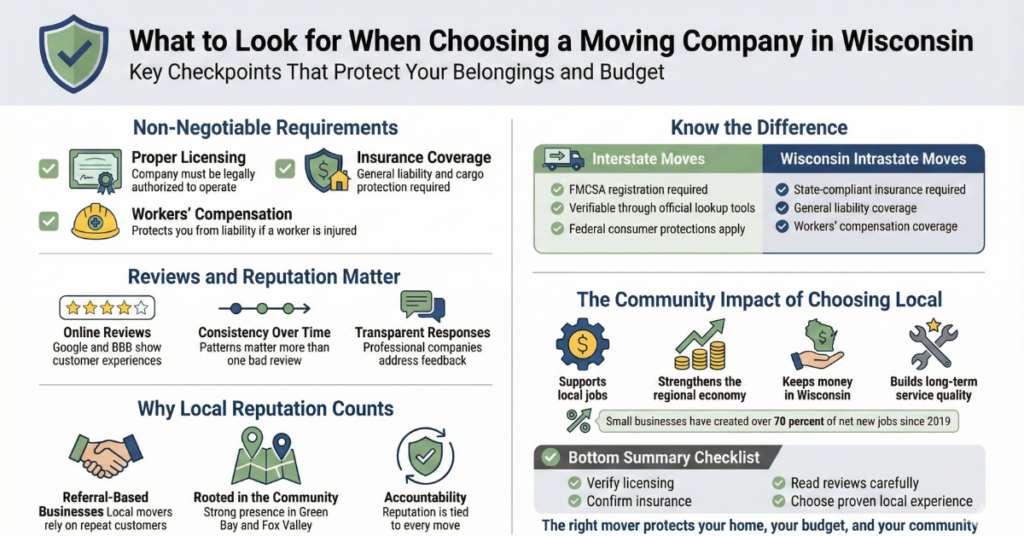
Any legitimate moving company should carry proper licensing and liability coverage. For interstate moves, you can verify a company’s registration through the FMCSA’s Protect Your Move lookup tool. For intrastate Wisconsin moves, check that the company carries general liability insurance and workers’ compensation coverage.
Reviews, Reputation, and Community Track Record
Online reviews on Google and the Better Business Bureau tell part of the story, but community reputation tells the rest. Local movers depend on referrals and repeat customers. A company with deep roots in Green Bay or the Fox Valley is staking its livelihood on every single move it completes.
According to the SBA and U.S. Treasury, small businesses have created over 70% of net new jobs since 2019. When you choose a locally owned mover, you are investing in the same community you call home.
Ready to Get a Local Moving Quote in Green Bay?
For most residential, apartment, and regional moves in Wisconsin, a local moving company gives you the best combination of value, flexibility, and personal accountability. National chains have their place for cross-country and corporate moves, but when your move stays within the state, local expertise wins.
Green Bay Moving Co. is a trusted, locally owned team that has helped families and businesses across Green Bay, Appleton, De Pere, Ashwaubenon, and surrounding Wisconsin communities move with confidence. Whether you need full packing support, specialty item handling, or a reliable crew for moving day, we are here to help.