





Most commercial landlords require your moving company to carry general liability insurance of at least $1 million per occurrence and provide a Certificate of Insurance (COI) before movers are allowed inside the building. If you are planning a business relocation in Green Bay or anywhere in Wisconsin, understanding these insurance requirements early can prevent costly delays on moving day and keep your lease in good standing.
Key Takeaways
- Commercial landlords typically require a Certificate of Insurance (COI) from your moving company that proves general liability coverage, workers’ compensation, and names the landlord as an additional insured party.
- Standard coverage minimums range from $1 million to $2 million per occurrence, though some commercial properties and high-rise buildings may require higher limits.
- Request your COI at least two weeks before moving day to give building management enough time to review and approve documentation.
- Failing to provide proper insurance documentation can result in your movers being turned away at the door, violating your lease, or leaving you personally liable for damages.
- Licensed and insured movers in Wisconsin must be registered with the Wisconsin Department of Transportation and carry proper liability coverage under state and federal regulations.
What Insurance Does Your Landlord Require for a Commercial Move?
When you sign a commercial lease, the insurance section is one of the most important parts of the agreement. Your landlord requires insurance to protect their building, other tenants, and themselves from financial losses that could result from your business operations or your move into the space. According to Insureon, most landlords require liability insurance so they will not have to cover the cost of an accident or injury at your business.
Patrick Abell, a real estate attorney and associate in the real estate practice group at Stoel Rives LLP, advises that landlords should have “an internal risk management professional or insurance broker review the insurance provisions of the lease to ensure coverage is adequate to underwrite the risks posed by the operation of the property.” That same vigilance applies to you as a commercial tenant preparing for a move.
General Liability Insurance
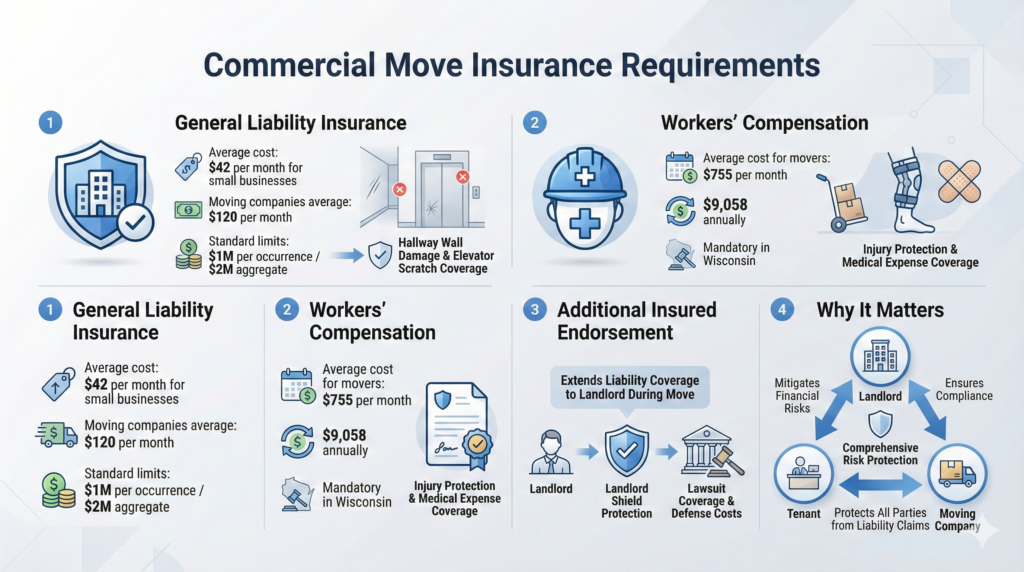
General liability insurance is nearly always the first requirement your landlord will list. This coverage protects against third-party bodily injury and property damage claims. For example, if a mover accidentally damages a hallway wall, scratches an elevator, or injures a visitor in the building during your move, general liability coverage pays for repairs and medical expenses.
According to Insurance Navy Brokers, general liability costs an average of about $42 per month (approximately $500 per year) for small businesses. The property risks and location of your business typically determine exact rates. Data from Insureon shows the average general liability policy for moving companies specifically runs about $120 per month with standard policy limits of $1 million per occurrence and $2 million aggregate.
Workers’ Compensation Coverage
Many commercial landlords also require your moving company to carry workers’ compensation insurance. This protects the building owner from liability if a mover gets injured while working on the property. Without workers’ comp, the landlord or even you as the tenant could be drawn into a claim for medical expenses if someone on the moving crew is hurt during the relocation.
According to Insureon’s cost data, moving companies pay an average of $755 per month, or $9,058 annually, for workers’ compensation insurance. This reflects the physically demanding nature of moving work, where back injuries and other incidents are common. In Wisconsin, workers’ compensation is mandatory for most employers, and landlords will expect to see active coverage documented on the COI.
Additional Insured Endorsement
Your landlord will almost certainly require being named as an “additional insured” on your moving company’s liability policy. As the Wright Law Firm NYC explains, being listed as an additional insured means the insurance covers the landlord if they are included in a lawsuit arising from a tenant’s activities. This protects the landlord from both the cost of defending a lawsuit and any adverse judgment.
Sarah Holmes, Esq., a business attorney who has taught commercial leasing Continuing Legal Education (CLE) courses for business owners at Holmes Legal Group, notes that commercial leases are often heavily landlord-friendly and may put your business assets and inventory at risk if insurance provisions are not properly negotiated. She recommends having an attorney review your lease before signing to make sure insurance terms are reasonable for both sides.
This endorsement is not optional in most commercial leases. If your moving company cannot name the building owner as an additional insured, you may need to find a different mover who can.
What Is a Certificate of Insurance (COI) and Why Do You Need One?
A Certificate of Insurance is one of the most important documents in any commercial move. Without it, your movers may not be allowed through the front door, and your entire moving timeline could be thrown off.
What a COI Covers
A COI is a document issued by your moving company’s insurance provider that verifies the company has adequate insurance coverage. According to 3 Men Movers, a COI ensures that the moving company has the necessary insurance coverage, including liability insurance and workers’ compensation. It also confirms that the insurance company backing the mover is legitimate and capable of covering damages if they occur.
The typical COI includes several types of protection. According to Roadway Moving, COIs usually cover umbrella coverage, cargo insurance, workers’ compensation, automotive liability, and general liability insurance, with most COIs providing coverage of around $1 million to $2 million per move. Some luxury buildings and commercial spaces require coverage as high as $10 million.
Who Issues the COI
The COI is issued by your moving company’s insurance carrier, not by the moving company itself. Your mover coordinates with their insurer to generate the document, which is then sent to your building management company and often to you as well.
According to FlatRate Moving, the COI must be approved by the management or board of your building, usually based on the level of coverage. Some buildings have very specific templates they want used, so it is a good idea to ask your building manager for their preferred format early in the planning process.
Most reputable moving companies provide COIs at no extra charge. Some movers in major metro areas may charge a small fee of $10 to $50 for this service, so ask upfront to factor it into your office moving checklist for small businesses.
How Much Coverage Do Commercial Landlords Typically Require?
Coverage requirements vary depending on the building, the landlord, and the type of commercial space you are leasing. However, industry standards give you a solid starting point for budgeting.
According to The Ephraim Group, landlords typically require at least $1 million per occurrence and $2 million aggregate in liability coverage. These figures are based on real-world claim data, not arbitrary numbers. Some landlords also require 30 days’ advance notice if the insurance policy is canceled, ensuring continuous coverage throughout your lease.
Shelly Benisch, CIC, TRS, a certified insurance counselor and transportation risk specialist with over 30 years of experience at Commercial Insurance Solutions, Inc. and recognized as one of Progressive’s Top 25 Truck Insurance Agency Leaders in 2024, notes that many brokers and customers expect to see proof of at least $1 million in combined single-limit coverage before they will work with a carrier. She advises that starting with the minimum is fine for getting your authority, but higher limits open better opportunities and provide stronger protection.
Here is a breakdown of common coverage requirements for commercial moves:
| Coverage Type | Typical Minimum | What It Protects |
| General Liability | $1M per occurrence / $2M aggregate | Third-party injuries, property damage |
| Workers’ Compensation | State-mandated minimums | Moving crew injuries on the job |
| Commercial Auto | $750,000 to $1M | Moving truck accidents, property damage |
| Umbrella/Excess Liability | $1M to $5M | Claims exceeding primary policy limits |
| Cargo/Inland Marine | $100,000+ | Your belongings during transit |
For businesses working with commercial moving services in Green Bay, your landlord may also require tenant legal liability (TLL) coverage. This specifically covers accidental damage you cause to the building you rent, most commonly from fire, water damage, or explosions.
Enhanced insurance protection for a commercial move typically adds 1% to 5% of the declared value of your shipment to your overall moving costs, according to Move Solutions. For a small office move valued at $50,000 in equipment, that means an additional $500 to $2,500 for comprehensive coverage.
What Happens If You Don’t Have the Right Insurance?
Skipping or overlooking insurance requirements during a commercial move can create serious problems, from logistical headaches to financial exposure that could threaten your business.
Lease Violations and Move-Day Delays
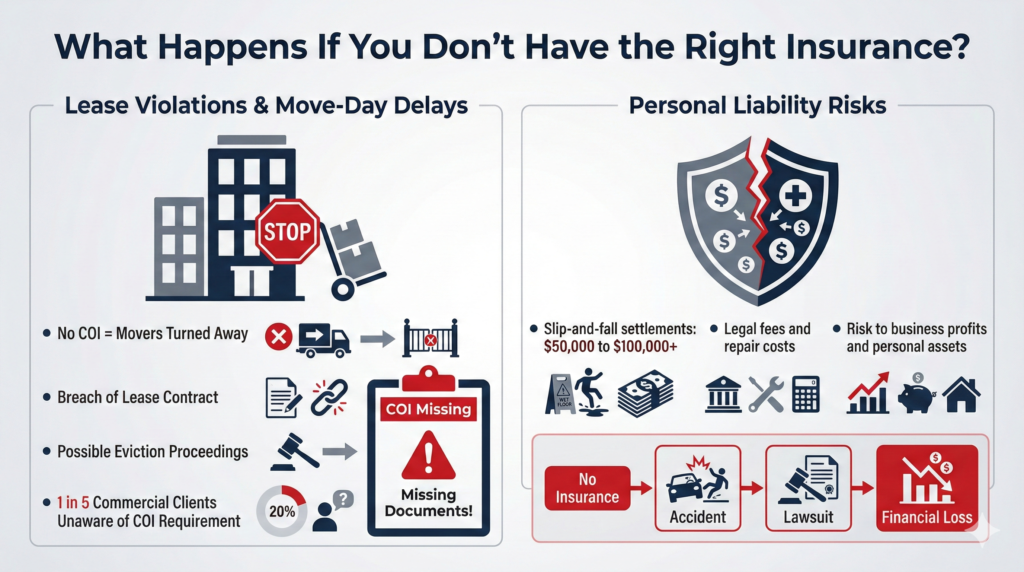
The most immediate consequence is that your movers may be turned away at the building. Many property management companies will not allow movers onto the premises without a valid COI. If your team shows up on moving day without the right paperwork, the move simply does not happen.
From our experience at Green Bay Moving Co., approximately 1 in 5 commercial move clients contact us without knowing they need a COI. That is why we proactively ask every commercial client about their building’s insurance requirements during the initial estimate, so there are no surprises on moving day.
Beyond moving day disruptions, operating without the insurance your lease requires is a breach of contract. According to The Ephraim Group, a lapsed insurance policy is a breach of contract, and your landlord will be notified and can begin eviction proceedings. That is a risk no business owner can afford to take, especially during the chaos of a relocation.
Personal Liability Risks
Without proper insurance, you as the business owner may be personally responsible for damages, medical bills, repair costs, and legal fees. Even limited liability protections have their limits when negligence is involved.
A single slip-and-fall incident at a commercial property can result in settlements ranging from $50,000 to over $100,000, according to insurance industry data from The Ephraim Group. Without coverage, those costs come directly out of your business profits or personal assets.
This is one of the biggest reasons to work with licensed and insured professional movers. When you know when to call professional movers and verify their coverage, you are protecting yourself and your business from these worst-case scenarios.
How Do You Get a COI for Your Commercial Move?
Getting your Certificate of Insurance does not have to be complicated if you plan ahead. Here is a simple process to follow:
- Contact your building management early. As soon as you know your move date, ask your landlord or property manager about their specific insurance requirements. Find out the minimum coverage amounts, whether they have a preferred COI template, and the deadline for submitting documentation. Plan to have this conversation at least three to four weeks before your move.
- Choose a licensed and insured moving company. Verify that the moving company is properly registered. In Wisconsin, intrastate movers must have motor carrier operating authority from the Wisconsin Department of Transportation, and interstate movers need a USDOT number and FMCSA registration. Ask for proof of general liability, workers’ comp, and commercial auto coverage before you sign a contract.
- Request the COI from your mover. Share your building management’s requirements with the moving company, including the landlord’s name, building address, and any specific coverage thresholds. Your mover will coordinate with their insurance carrier to generate the COI. According to Insureon, most small business owners can get coverage and proof of insurance within 24 hours of applying.
- Review the COI carefully. Before sending it to your landlord, check that the document includes the correct building address, your landlord is named as an additional insured (not just a certificate holder), coverage amounts meet or exceed the lease requirements, policy dates are current and cover your move date, and the moving company’s contact information is accurate.
- Submit the COI to building management. Most buildings want the COI at least 24 to 48 hours before the move, though some may require it a week or more in advance. Send it early to allow time for review, questions, or corrections.
- Keep a copy for your records. Hold onto the COI along with your bill of lading, moving contract, and inventory list. These documents are essential if you ever need to file a claim or resolve a dispute.
If your mover has trouble providing a COI or resists the request, that is a red flag. Any reputable, licensed moving company will be familiar with this process and should handle it as part of their standard service. You might be surprised by some of the things you didn’t know movers can handle, including this kind of paperwork.
What Is the Difference Between Valuation Coverage and Moving Insurance?
One area that often causes confusion during a commercial move is the difference between valuation coverage and actual moving insurance. These are not the same thing, and knowing the difference can save you thousands of dollars.
The Federal Motor Carrier Safety Administration (FMCSA) requires interstate movers to offer two types of valuation coverage. Released Value Protection is included at no additional cost, but it only reimburses you at $0.60 per pound per article. That means a 25-pound flat-screen TV would only get you $15 in compensation if it is lost or destroyed. Full Value Protection is more comprehensive and makes the mover responsible for the replacement value of lost or damaged goods in your entire shipment, though it does come at an additional cost.
Valuation coverage is not insurance. It is the mover’s liability level, and it only applies when the moving company is negligent. Actual moving insurance is a separate policy issued by a licensed insurance company that provides broader protection, including coverage for events outside the mover’s control like severe weather or accidents.
For commercial moves involving expensive office equipment, servers, or specialized machinery, relying on basic valuation coverage alone is risky. Consider purchasing additional third-party moving insurance or checking whether your existing business property insurance covers items in transit. The Wisconsin Department of Agriculture, Trade and Consumer Protection recommends that consumers adequately insure their belongings and verify that the mover they select has proper insurance before the move begins.
Ready for a Stress-Free Commercial Move in Green Bay?
Navigating commercial move insurance requirements does not have to be stressful. The key is starting early, choosing a licensed and insured moving company, and communicating clearly with your landlord about what documentation they need.
When your mover has the right coverage and your COI is approved ahead of time, moving day can focus on what matters: getting your business into its new space and back to work. Whether you are relocating a small office in Ashwaubenon or moving an entire operation across Green Bay, planning ahead for insurance gives you the peace of mind that everything is covered.
Need help with your next commercial move? Our crew at Green Bay Moving Co. is licensed, insured, and experienced with commercial relocations across Wisconsin. We handle the COI process, coordinate with your building management, and make sure every box is checked before moving day. Contact us today for a free quote and let’s make your business move a smooth one.