





Most residential gun safes weigh between 200 and 1,500 pounds, require at least 32 inches of doorway clearance, and need floor protection like plywood sheets or rubber mats during every move. Whether you are relocating across Green Bay or moving to a new home in Appleton, De Pere, or anywhere in Wisconsin, understanding gun safe weights, clearance measurements, and floor protection is the difference between a smooth move and costly damage to your home.
Gun safes are built to be heavy on purpose. That weight is what keeps your firearms secure, but it also makes moving one of the most physically demanding tasks in any residential relocation. Flooring damage is one of the most common types of property harm during heavy item moves, according to industry reports from Let’s Get Moving USA. The good news? With the right preparation and the right crew, your gun safe can be relocated without a single scratch on your floors or walls.
Key Takeaways
- Residential gun safes weigh between 200 and 1,500+ pounds, with mid-range models averaging 600 to 1,000 pounds
- Standard interior doors are only 28 to 32 inches wide, so you need to measure every doorway, hallway, and stairwell before moving day
- Protect hardwood, tile, and laminate floors by laying plywood sheets, rubber mats, or heavy-duty moving blankets along the entire travel path
- Most residential floors support 40 pounds per square foot, which means heavy safes should be placed near load-bearing walls or on concrete
- Professional gun safe movers typically cost $175 to $525 for local moves and bring specialized equipment most homeowners do not have access to
How Much Does a Gun Safe Weigh?
Gun safe weight depends on the size of the unit, the thickness of the steel, the number of fire-resistant insulation layers, and the overall design of the safe. Even a modest entry-level gun safe starts at around 200 pounds, while high-end residential models can exceed 1,600 pounds. According to Liberty Safe, one of the largest gun safe manufacturers in the United States, commercial-grade safes can weigh up to 5,000 pounds.
Understanding where your gun safe falls in the weight spectrum is the first step in planning a safe and successful move.
Gun Safe Weight by Size Category
| Safe Category | Gun Capacity | Typical Weight Range |
| Small / Handgun Safe | 1-10 firearms | 20 to 200 lbs |
| Entry-Level Gun Safe | 12-24 firearms | 200 to 600 lbs |
| Mid-Range Gun Safe | 24-48 firearms | 600 to 1,000 lbs |
| High-End Gun Safe | 30-60+ firearms | 1,000 to 1,600 lbs |
| Commercial-Grade Safe | Varies | 2,000 to 5,000 lbs |
Source: Liberty Safe weight data and USA Safe & Vault
What Makes Gun Safes So Heavy?
Several construction features contribute to the extreme weight of a gun safe. The primary factors include the gauge of the steel body, fire-resistant insulation layers, and the door assembly.
Steel thickness plays the biggest role. Top-quality gun safes are built from 12-gauge to 7-gauge steel, according to safe industry experts at The Safe Keeper. Thinner steel (14-gauge or higher) produces a lighter safe but offers less burglary protection.
Fire insulation adds significant weight. Many gun safes contain multiple layers of fireboard, a gypsum-based material pressed between sheets of paper. Some high-end models include four layers of fireboard, each measuring 5/8 inch to 2 inches thick. This layered construction is what gives a quality safe its fire rating, but it also adds hundreds of pounds.
Door assemblies are often the heaviest single component. Gun safe doors contain thick steel plates, locking bolts, and additional insulation. Even slight movement of an unlocked door during transport can shift the center of gravity without warning, which is why Boxstar Movers note that the door deserves special attention before any gun safe move begins.
Will Your Gun Safe Fit Through the Doorway?
Measuring doorway clearance before moving day is the single most overlooked step in any gun safe relocation. A gun safe that cannot fit through your front door, hallway, or basement stairwell can bring your entire move to a halt and force expensive last-minute adjustments. According to Liberty Safe’s installation guide, the width of your door jamb is the first measurement any safe delivery service will check, and it is often the deciding factor in what size safe you can own.
Standard Door Widths vs. Gun Safe Dimensions
Most homeowners assume their doors are wide enough for a gun safe. Unfortunately, the numbers often tell a different story. According to Bob Vila, a trusted home improvement authority, the standard interior door width in the United States is just 32 inches, while exterior doors are typically 36 inches wide.
Here is how standard door widths compare to common gun safe dimensions:
| Door Type | Typical Width | Gun Safe Clearance Notes |
| Interior bedroom/hallway door | 28-32 inches | Tight fit for most mid-range safes |
| Exterior front/back door | 36 inches | Fits most residential gun safes |
| Closet door | 24-30 inches | Too narrow for most gun safes |
| ADA-compliant door | 36 inches | Best option for gun safe access |
Mid-range and large gun safes commonly measure 30 to 40 inches wide. That means a standard 32-inch interior door leaves zero clearance for many models, especially when you factor in the door frame, hinges, and the width of the moving dolly.
How Do You Navigate Tight Spaces With a Gun Safe?
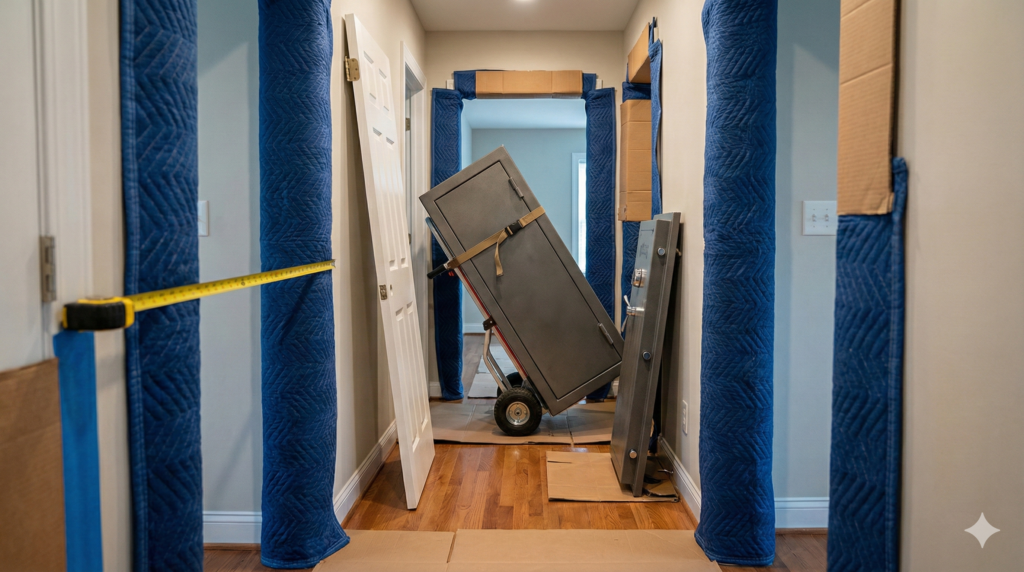
When doorways are tight, professional movers use several proven techniques to get a gun safe through safely. American Security (AMSEC) recommends measuring doorways and hallways ahead of time and notes that if the safe is too wide, you may need to remove doors from their hinges or reposition the safe on the dolly at a slight angle.
Here are the steps experienced movers follow for tight spaces:
- Measure every passage with a tape measure, including doorways, hallways, stairwells, and any turns along the route
- Remove interior doors from their hinges to gain an extra 1.5 to 2 inches of clearance
- Remove the safe door if the manufacturer allows it, since the door is often the heaviest part and reducing width helps clear tight spots
- Angle the dolly carefully through narrow passages while keeping the safe slightly tilted back for ground clearance
- Pad all door frames and corners with moving blankets or cardboard to prevent wall and trim damage
Liberty Safe even suggests taping a cardboard mock-up of your safe with the correct dimensions and doing a test run through the house before moving day, according to their DIY moving tips guide. This simple step can save you from discovering a problem when a 1,000-pound safe is already strapped to a dolly in your hallway.
How Do You Protect Floors When Moving a Gun Safe?
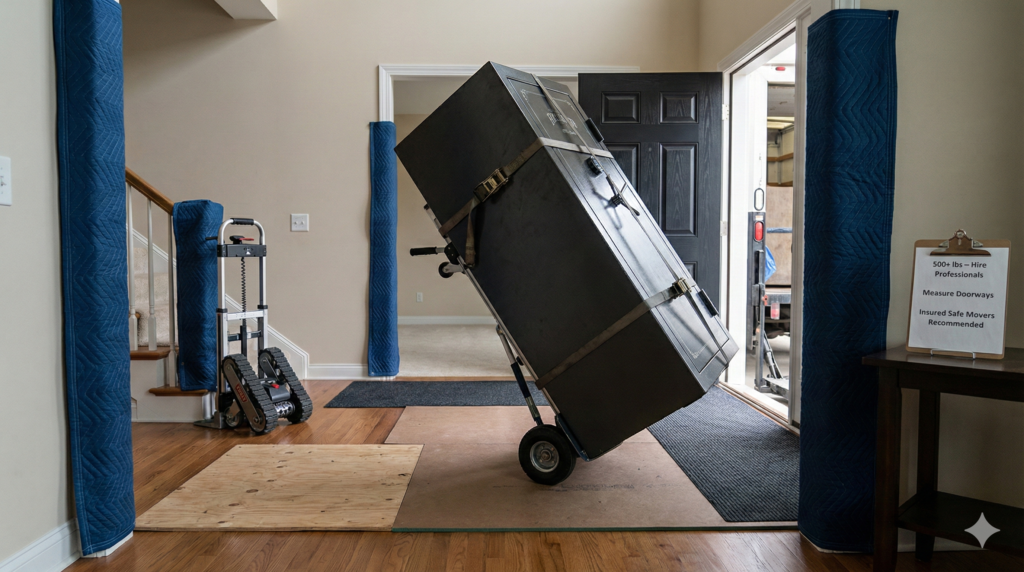
Gun safes apply extreme pressure to small surface areas, which makes floor protection just as important as securing the safe itself. Hardwood floors, tile, laminate, and even concrete can suffer cracking, compression marks, or permanent dents when a heavy safe is rolled or dragged across them without proper precautions. According to moveBuddha, a leading moving resource, laying down Masonite sheets or plywood along the moving path helps distribute weight more evenly and protects floors from dolly wheels.
Hardwood and Laminate Floor Protection During the Move
Hardwood and laminate floors are especially vulnerable during a gun safe move. The concentrated weight of the safe on dolly wheels can leave permanent grooves, scratches, and compression marks that are difficult or impossible to repair.
Here is what professionals lay down before rolling a gun safe across your floors:
- Plywood sheets (1/2 inch thick): Distributes the weight across a wider surface area and provides a smooth rolling path for the dolly
- Heavy-duty moving blankets: Moving blankets protect against scratches and dents by creating a soft barrier between the dolly wheels and your floor
- Masonite or hardboard sheets: Lightweight and easy to lay down, these sheets create a firm rolling surface without gouging your floors
- Commercial-grade floor runners: Professional movers in Wisconsin use these to cover long stretches of hallway and entryway
A common mistake homeowners make is protecting only the area directly under the safe. The entire travel path from the safe’s current location to the moving truck (and from the truck into the new home) needs protection. Every transition point, including door thresholds and ramps, is a high-risk zone for floor damage.
What Should You Place Under a Gun Safe After Installation?
Once your gun safe reaches its final position, floor protection does not stop. The long-term weight of a gun safe sitting on hardwood, tile, or carpet can cause gradual damage if nothing is placed underneath.
According to Liberty Safe’s floor protection guide, many professional gun safe installers use dense, 1/4-inch-thick, 4-by-6-inch felt pads under each corner of the safe. These adhesive-backed pads keep the safe directly off the floor and prevent pressure marks.
Other effective options include:
- Rubber mats: Prevent moisture buildup between the safe and the floor, which can cause both rust on the safe and damage to hardwood over time
- 1/2-inch plywood platforms: Cut slightly larger than the safe’s footprint to spread the load evenly, especially on softer hardwoods like cherry
- Carpet remnants or thick felt pads: Budget-friendly options that prevent scratches and distribute weight
Liberty Safe also recommends installing a rubber mat under your safe before bolting it down, particularly in basements or humidity-prone areas where moisture can pool unnoticed beneath the safe.
Can Your Floor Handle the Weight of a Gun Safe?
Placing a gun safe on a floor that cannot support its weight is a serious structural concern. While most residential floors are built to handle typical household furniture, a 1,000-pound gun safe concentrates that weight into a footprint of just 6 to 10 square feet, creating localized stress that exceeds what many floor systems were designed for.
Residential Floor Load Capacity Basics
The International Residential Code (IRC), on which most U.S. building codes are based, requires that floors in non-sleeping rooms support a minimum live load of 40 pounds per square foot (psf). Bedroom floors must support at least 30 psf.
Here is what that means in practical terms for gun safe owners:
- A gun safe with a 2-foot by 4-foot footprint covers 8 square feet
- At 40 psf, that area supports approximately 320 pounds of live load
- A 600-pound mid-range safe already exceeds that threshold when placed on a standard wood-framed floor without additional support
According to Sportsman’s Warehouse, most residential wood floors are designed to support 40 to 50 pounds per square foot. They recommend placing an oversized wood platform between the safe and the floor to distribute weight away from the corners, where pressure concentrates.
It is important to note that building code minimums include a safety factor, so floors do not immediately fail at their rated load. However, long-term loading beyond the design capacity can cause joist sagging, floor deflection, and structural damage over time.
Best Placement Locations for Heavy Safes in Your Home
Where you place your gun safe matters just as much as how you move it. Strategic placement can prevent structural issues and keep your safe more secure.
Best locations for a heavy gun safe:
- Concrete basement floors: Offer the strongest support with virtually no weight concerns
- Ground-floor rooms over concrete slabs: Ideal for homes built on slab foundations
- Against exterior or load-bearing walls: These walls sit directly over the foundation and transfer weight more efficiently
- Over floor joists (not between them): Positioning the safe so its weight lands on or near a joist provides better support
Locations to avoid for heavy gun safes:
- Upper floors in wood-framed homes: Second-story bedrooms are rated for just 30 psf, making them risky for heavy safes
- Center of a room far from walls: Weight in the middle of a joist span creates maximum deflection
- Over long, unsupported joist spans: The longer the span between supports, the less weight the floor can handle
If you plan to place a gun safe on an upper floor or over a long joist span, consult a structural engineer or contractor to determine whether floor reinforcement is needed.
Should You Hire Professional Gun Safe Movers or Do It Yourself?
Moving a gun safe is one of those tasks where the risks of doing it yourself often outweigh the cost savings. According to data from MyGoodMovers, over 21,000 people in the United States end up in the emergency room each year due to moving-related injuries, and heavy items like gun safes are among the most dangerous to relocate without proper training and equipment.
Liberty Safe, the leading U.S. gun safe manufacturer, consistently recommends hiring professional, insured safe movers for all relocations, stating that professionals possess the experience, specialized equipment, and insurance to handle the job safely and efficiently, as noted in their safe relocation guide.
What Professional Movers Bring to the Job
Professional gun safe movers are not the same as general furniture movers. They carry specialized equipment that most homeowners do not have access to, including:
- Heavy-duty appliance dollies rated for 1,000+ pounds
- Stair-climbing dollies with motorized treads for safe navigation of stairways
- Industrial-grade ratchet straps to secure the safe tightly to the dolly frame
- Hydraulic lift gates on moving trucks for loading and unloading
- Plywood, Masonite, and commercial floor runners to protect your home
- Corner guards and door frame padding to prevent wall and trim damage
Beyond equipment, experienced gun safe movers understand how a safe’s forward-heavy center of gravity affects stability during transport. They know how to balance the safe on a dolly, communicate as a team through tight spaces, and manage the safe at high-risk transition points like door thresholds, ramps, and stair landings.
If you are in Green Bay, Appleton, De Pere, or anywhere in the surrounding Wisconsin communities, our crew at Green Bay Moving Co. specializes in safe moving services in Green Bay and professional heavy item moving. We bring the right tools and the right experience so you do not have to risk your back, your floors, or your safe.
Not sure if your move calls for professional help? Here is a good rule of thumb: if your gun safe weighs over 500 pounds or needs to go up or down stairs, it is time to call professional movers. You might also be surprised by the things you didn’t know movers can handle, including safes, pianos, and other specialty items.
How Much Does Professional Gun Safe Moving Cost?
The cost of hiring professional gun safe movers depends on the weight and size of the safe, the distance of the move, and any access challenges like stairs, tight doorways, or upper-floor placement.
Here is a general breakdown of what to expect:
| Move Type | Typical Cost Range |
| Local move (same city) | $175 to $525 |
| Average U.S. gun safe move | Approximately $295 |
| Long-distance move | $500 and up |
| Stair carry or upper-floor placement | Additional $50 to $200+ |
Sources: Liberty Safe,Moving Help Marketplace,moveBuddha
A DIY approach might seem cheaper at first, but renting a heavy-duty dolly, straps, floor protection, and a truck with a lift gate can still cost $40 to $65 or more, according to Angi. Factor in the risk of back injuries, damaged floors, or a dented safe, and the professional option often pays for itself.
Ready to Move Your Gun Safe Without the Stress?
Moving a gun safe takes more than muscle. It takes the right measurements, the right equipment, and a crew that knows how to handle 500 to 1,500 pounds of steel, fireboard, and locking mechanisms without damaging your home or putting anyone at risk.
If you are planning a move in Green Bay, Appleton, De Pere, Ashwaubenon, Suamico, or anywhere in the surrounding Wisconsin area, our team at Green Bay Moving Co. is here to help. We specialize in gun safe moving and heavy item relocation with the tools, training, and care your move deserves.
Give us a call at (920) 819-1545 or request a free quote today. Let’s make your next move a smooth one.