Skip to content






A binding estimate locks in a fixed price for your move based on a written inventory, so you pay the quoted amount even if your shipment weighs more. A non-binding estimate is an approximation that adjusts based on actual weight and services, capped at 110% of the quote at delivery under federal law. Binding estimates protect your budget; non-binding estimates can save money if you pack light.
Key Takeaways
- A binding estimate guarantees a fixed price; a non-binding estimate can change based on actual weight and services
- Federal law (FMCSA) caps non-binding charges at 110% of the estimate at delivery, with any remainder billed within 30 days
- Binding estimates favor predictability; non-binding estimates favor flexibility and possible savings
- A binding not-to-exceed estimate combines both benefits: a price ceiling with the chance to pay less
- Always get the estimate in writing, never sign blank or incomplete documents
- For local Green Bay moves, hourly pricing usually replaces weight-based estimates entirely
What Is a Binding vs Non-Binding Estimate?
A moving estimate is a written quote from a mover detailing what your relocation will cost based on weight, distance, services, and accessorial fees. The two main types behave very differently when the final bill arrives, and choosing the right one protects your wallet on moving day.
How a Binding Estimate Works
A binding estimate is a written agreement that guarantees the total cost of your move based on the inventory and services listed. According to the Federal Motor Carrier Safety Administration (FMCSA), the carrier and customer are bound by the charges shown on the estimate. The price stays fixed even if your shipment ends up heavier than expected. If you add items or request extra services after signing, the mover must issue a revised binding estimate before loading begins.
“A binding estimate is your strongest protection against surprise charges, but it only stays binding if your inventory does not change between the quote and moving day,” says the lead estimator at Green Bay Moving Co.
How a Non-Binding Estimate Works
A non-binding estimate is the mover’s best approximation of your final cost, calculated from the estimated weight of your shipment and the services requested. The FMCSA confirms that final charges on a non-binding estimate are based on actual weight, services provided, and the carrier’s published tariff in effect. The truck is weighed empty, then weighed loaded, and the difference determines what you pay. If your stuff weighs less than estimated, you save. If it weighs more, you pay more, but never more than 110% at delivery.
What Are the Pros and Cons of a Binding Estimate?
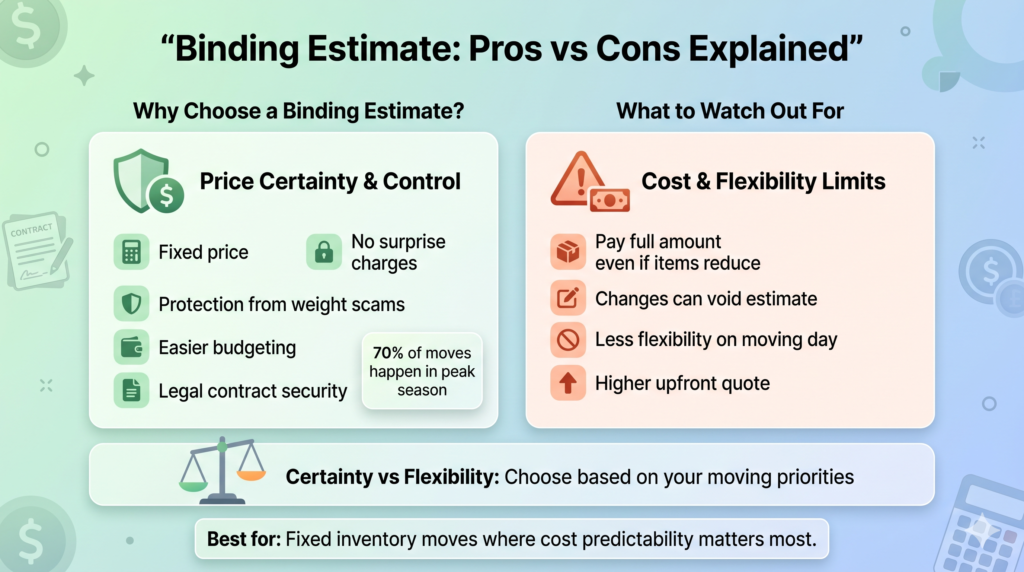
A binding estimate trades a slightly higher upfront quote for total cost certainty. It works best when you know exactly what you are moving and want zero surprises on delivery day.
Pros: Price Certainty and Budget Control
- Fixed price you can budget around. No matter what the truck scale shows, you pay the estimated amount.
- Protection from weight-bumping scams. Dishonest movers sometimes inflate weight on a non-binding move to pad the bill. A binding contract removes that risk.
- Easier financial planning. Roughly 7 in 10 households move during peak season (May through September), when fuel and labor surcharges spike. A binding rate locks you in before the market shifts.
- Stronger legal footing. Federal regulations require the words “Binding Estimate” to appear clearly on the document, giving you a written contract to enforce.
Cons: Higher Upfront Cost and Less Flexibility
- You pay the full quote even if you pack lighter. Decluttered after the survey? You still owe the binding amount.
- Inventory changes void the original price. Add a couch on moving day and the mover can either refuse the job, write a revised binding estimate, or convert it to non-binding.
- Higher quoted price upfront. Movers add a buffer to protect themselves from underestimating, so the headline number is usually steeper than a non-binding quote for the same load.
What Are the Pros and Cons of a Non-Binding Estimate?
A non-binding estimate offers flexibility and potential savings, but the final cost depends on what the scale says. It rewards customers who can accurately predict their load and trust their mover.
Pros: Lower Upfront Quote and Flexibility
- Often a lower starting price. Because the mover does not need a buffer for unknowns, the quoted figure is usually less than a binding equivalent.
- You pay actual usage. If your shipment weighs less than estimated, your bill drops accordingly.
- Flexibility for last-minute changes. Adding or removing items is easier without breaking the contract.
- Federal weight verification required. Per 49 CFR Part 375, the carrier must determine the actual weight of every non-binding shipment before assessing charges, so you cannot be billed off thin air.
Cons: Risk of a Higher Final Bill
- Final cost is unpredictable. Underestimating weight can mean a bill that exceeds your budget by hundreds of dollars.
- The 110% rule still leaves you owing more later. The mover can collect 110% of the estimate at delivery, but any remainder is billed within 30 days.
- Higher exposure to underestimation tactics. Some rogue carriers deliberately lowball non-binding quotes to win the job, then inflate the final bill.
What Is the 110% Rule and How Does It Protect You?
The 110% rule is a federal consumer protection that applies only to non-binding estimates on interstate moves. The FMCSA states that a carrier cannot demand more than 110% of the non-binding estimate at the time of delivery, even if your actual charges run higher. Any balance above that 110% threshold must be billed within 30 days after delivery, not collected at the curb.
This rule exists to stop the “hostage load” tactic, where dishonest movers inflate the bill on delivery day and refuse to unload until the customer pays. If a carrier holds your goods for more than 110% of a non-binding estimate, you can file a complaint with FMCSA at 1-888-DOT-SAFT. Carriers found in violation face penalties of a minimum of $500 per day per violation, with possible loss of operating authority.
For binding estimates, the rule is even stricter: the carrier cannot collect more than 100% of the binding amount at delivery for services already in the contract.
Binding vs Non-Binding: Quick Comparison Table
| Feature | Binding Estimate | Non-Binding Estimate |
| Final price | Fixed at the quoted amount | Based on actual weight and services |
| Upfront quote | Usually higher | Usually lower |
| Maximum due at delivery | 100% of estimate | 110% of estimate |
| Inventory changes | Voids original price | Easier to absorb |
| Best for | Predictable inventories | Flexible loads, accurate estimators |
| Risk | Paying more than actual weight justifies | Final bill exceeds budget |
| FMCSA written-document rule | Yes, must say “Binding Estimate” | Yes, must say “Non-Binding Estimate” |
Which Estimate Type Should You Choose for Your Green Bay Move?
The right choice depends on three things: how confident you are about your inventory, how much you value cost certainty, and whether your move crosses state lines. Use the scenarios below to match the estimate type to your situation, and review our moving cost calculator guide before requesting quotes.
When a Binding Estimate Makes Sense
Choose a binding estimate when you have a stable inventory, are moving long-distance, and want a firm number to plan around. It is also smart during peak season (roughly 45% of all U.S. moves happen between Memorial Day and Labor Day) when prices climb. Specialty items like pianos, gun safes, and large appliances also benefit from a binding contract because the mover commits to the equipment and labor required.
When a Non-Binding Estimate Makes Sense
Choose a non-binding estimate when your load could shrink before moving day, you are downsizing, or you trust your in-home survey to be accurate. Many seniors and first-time homebuyers also prefer non-binding because they may declutter further between booking and the move. If you are still deciding between hourly and flat-rate billing, our guide on flat-rate vs hourly pricing walks through both side by side.
What About Local Moves in Wisconsin?
Local moves within Wisconsin (typically under 50 miles) are usually billed by the hour, not by weight. The crew clock starts when they arrive and stops when the truck is unloaded, with rates set per crew member per hour plus a truck fee. Federal binding/non-binding rules apply mostly to interstate moves, so for a Green Bay-to-Appleton or Allouez-to-De Pere relocation, ask for an hourly quote with a written cap or minimum.

How Do You Avoid Moving Estimate Scams?
Moving fraud costs U.S. consumers millions every year, and underestimated quotes are one of the top complaints in the FMCSA database. A few simple checks can save you thousands.
- Demand a written estimate after an in-home or video survey. FMCSA rules require a physical or virtual survey unless you waive it in writing.
- Never sign blank documents. A blank bill of lading or estimate gives the mover room to add charges later.
- Verify licensing. Check the mover’s USDOT and MC numbers at protectyourmove.gov before booking.
- Get at least three written estimates. Industry advice from the AMSA Consumer Handbook recommends comparing three quotes minimum to spot lowball outliers.
- Read the bill of lading before signing. Damaged items, delays, and missing items all start with paperwork. Our guide on filing moving claims covers what to document.
- Ask about valuation coverage. Your contract should explain whether you have released value (60 cents per pound) or full value protection, which determines what gets reimbursed if something breaks.
“The number one mistake we see is customers signing without reading the inventory list line by line,” says a senior crew lead at Green Bay Moving Co. “Spend ten minutes checking the paperwork and you can prevent ten weeks of disputes.”
Ready for Honest Pricing on Your Next Move?
Choosing between a binding and non-binding estimate comes down to how much certainty you want and how stable your inventory is. Binding gives you peace of mind and a fixed price; non-binding gives you flexibility and possible savings; and a binding not-to-exceed estimate offers the best of both for most households.
At Green Bay Moving Co., our trusted Green Bay moving company team gives you a clear, written estimate with no hidden fees. Whether you are relocating across town or across Wisconsin, we walk you through every line item so you know exactly what you are paying for before moving day. Call us today for a free, transparent quote and let our friendly crew make your next move stress-free.