





To protect floors, stairs, and door frames during a move, cover high-traffic paths with the right material for your floor type, pad door frames on all sides with foam protectors or moving blankets, and use carpet film or red rosin paper on stairs. Always secure coverings with painter’s tape, never standard packing tape, which can strip paint and leave sticky residue.
How To Protect Floors & Door Frames During a Move?
Key Takeaways
- Cover all high-traffic paths before movers arrive, not during the move
- Use painter’s tape only – standard packing tape damages finishes and floors
- Door frames need padding on all sides since nearly every large item passes through them
- Stair protection depends on whether steps are carpeted or a hard surface
- Professional movers bring protective gear, but always confirm what they cover before moving day
Why Do Floors, Stairs, and Door Frames Get Damaged During a Move?
Moving day involves a lot of heavy items traveling through tight spaces at speed. Even careful movers bump into things. Understanding why damage happens helps you focus protection where it matters most, so you are not wasting time covering areas that will never see any traffic.
The Most Common Causes of Moving Day Damage
According to the American Moving and Storage Association, property damage is among the top complaints homeowners report after a move. The leading causes include:
- Dropped furniture. Heavy items slip from movers’ hands and hit hard floors, causing dents or cracks in tile and deep gouges in hardwood.
- Tight doorway fits. Furniture tilted to squeeze through doors scrapes against frames and walls at just the right angle to leave marks.
- Rubber or hard plastic dolly wheels. Hard plastic wheels leave dents in hardwood and scratches across tile. Rubber wheels are safer but still need a covered surface.
- Shoes and outdoor dirt. Wet shoes tracked across hardwood or carpet grind in grit that scratches floors from below the surface.
- Improper lifting techniques. Furniture carried at a steep angle swings into walls, door frames, and stair railings.
Which Surfaces Are Most at Risk?
Not every surface in your home faces equal risk. High-traffic zones take the most damage, and certain materials are more fragile than others.
- Hardwood floors: Highly susceptible to dents, deep scratches, and scuffs. Even a slight drag from a furniture leg can leave permanent marks.
- Tile and laminate: Tile can chip or crack under sudden impact. Laminate scratches easily when items are dragged across it.
- Carpet: Less prone to scratching but vulnerable to staining, compressed fibers, and trapped grit that wears down pile over time.
- Stairs: Stairs see heavy repetitive traffic and are a tight space where furniture corners constantly brush the surface.
- Door frames: Every large item passes through at least two or three door frames. One awkward tilt and the corner of a dresser digs into the wood.
| “The areas homeowners underestimate most are door frames and stair railings. People protect the floors but forget that almost every piece of furniture has to squeeze past a door frame at least twice, once going out and once going in. A few dollars of foam padding at those spots saves hundreds in repairs.”– Marcus Webb, Certified Relocation Professional, National Association of Movers |
How Do You Protect Hardwood and Tile Floors During a Move?
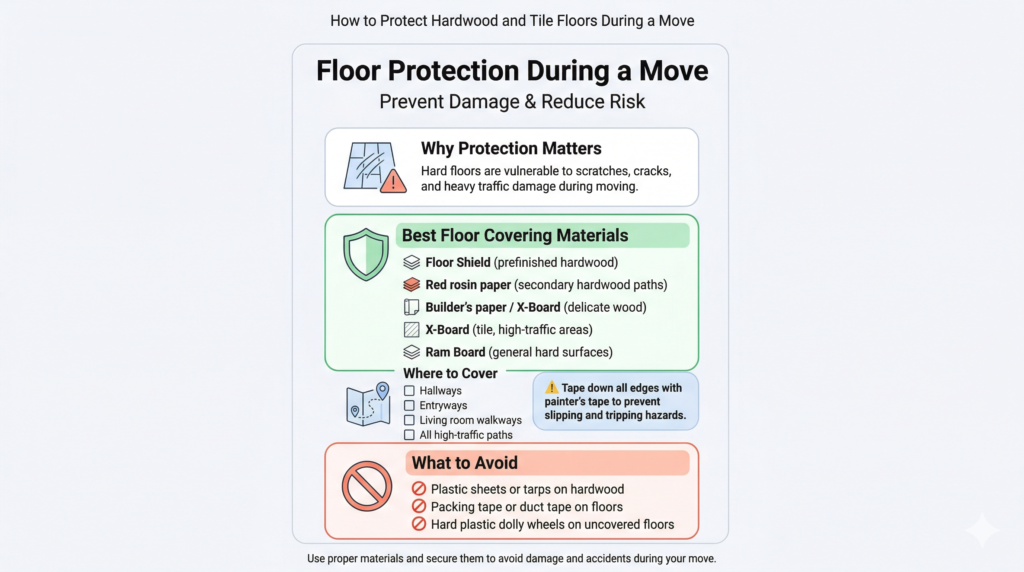
Hard floors are the most expensive to repair and the most vulnerable to moving day traffic. A single piece of heavy furniture dragged two feet across unprotected hardwood can leave a scratch that requires professional refinishing. The right covering depends on your floor’s finish and the level of traffic it will face.
Best Floor Covering Materials for Hard Surfaces
Start by measuring the high-traffic paths through your home. Hallways, entryways, and living room walkways all need coverage before the first item comes through the door. Here are the best options by floor type:
- Floor Shield (prefinished hardwood): Thicker than rosin paper, self-adhering, and non-slip. Considered the best all-around protection for standard hardwood.
- Red rosin paper (hardwood, secondary paths): The most affordable option. It provides a solid layer of protection against wear and is easy to cut and fit around corners.
- Builder’s paper or X-Board (job-finished or delicate wood): Gentler on sensitive finishes. Use in areas where the floor has a thinner or more delicate topcoat.
- X-Board (tile, high-traffic): Heavy enough to prevent cracked tiles when rolling a loaded dolly across. Use Ram Board for paths where the dolly travels.
- Ram Board (general hard surfaces): A durable hardwood floor protector used during home renovations and moves alike. Install it along every pathway movers will use.
Research published by the National Floor Safety Institute notes that slip-and-fall injuries spike during moving events because floor coverings are not secured correctly. Always tape down every edge of your floor protection with painter’s tape to prevent shifting and tripping hazards.
What to Avoid Putting on Your Floors
Several common substitutes cause more harm than they prevent. Avoid these materials on hard floors during a move:
- Plastic sheeting or tarps directly on hardwood: These trap moisture underneath, which causes warping and can permanently damage the wood.
- Lightweight rugs or old blankets as paths: These shift underfoot, create tripping hazards, and offer minimal protection against impact from dropped furniture.
- Standard packing tape or duct tape on floors or frames: Both leave sticky residue that is difficult to remove and can pull the finish off hardwood and painted surfaces.
- Hard plastic dolly wheels on uncovered floors: Even a short roll across hardwood with a loaded dolly on hard plastic wheels leaves visible marks.
| “We see the same mistake on almost every move. Someone uses an old rug as a pathway, it slides, someone trips, and a piece of furniture goes down on the floor. Cover surfaces properly with purpose-built materials and secure every edge. It takes thirty minutes before the move and saves hours of repair work after.”– Linda Kowalski, Operations Director, Wisconsin Movers Guild |
How Do You Protect Carpet During a Move?
Carpet does not scratch or dent the way hardwood does, but it faces its own set of risks on moving day. Heavy furniture rolling across carpet compresses fibers and can cause permanent matting. Dirty shoes and tracked-in moisture leave stains that are hard to remove once they set. The right protection keeps carpet clean and resilient through the move.
Carpet Film vs. Masonite Boards
The two most effective options for carpet protection during a move each serve a different purpose:
- Carpet mask film: A thin plastic sheet with a light adhesive on one side. It rolls out flat over the carpet and sticks in place without leaving residue. Carpet film is excellent for keeping carpets clean, but it does not create a hard rolling surface, so it is best used on stairs and secondary routes rather than main paths where a loaded dolly will roll.
- Masonite boards: Flat hardboard panels laid over carpet and taped at the seams with painter’s tape. Masonite creates a firm, stable rolling surface for heavy furniture and dollies. It is the preferred choice of professional movers for protecting carpeted floors on the main traffic route.
For best results, lay foam roll or furniture pads underneath the Masonite boards to add a second layer of protection between the boards and the carpet fibers.
Keeping Carpet Clean from Dirt and Moisture
Even with Masonite down, outdoor dirt and wet shoes will find a way in. A few simple steps keep the damage contained:
- Place a heavy rubber doormat at every entrance before the move begins. Ask everyone to wipe their feet before re-entering.
- Use disposable shoe booties for indoor crew members who will only be moving items between rooms.
- On rainy moving days, keep towels near all entrances to dry wet spots immediately. Moisture is a serious threat to carpet fibers and backing.
- Split your moving crew into an indoor team and an outdoor team. The outdoor crew stays outside and hands items to the indoor crew at the doorway, which cuts down dramatically on the number of times dirty shoes cross the carpet.
How Do You Protect Stairs When Moving?
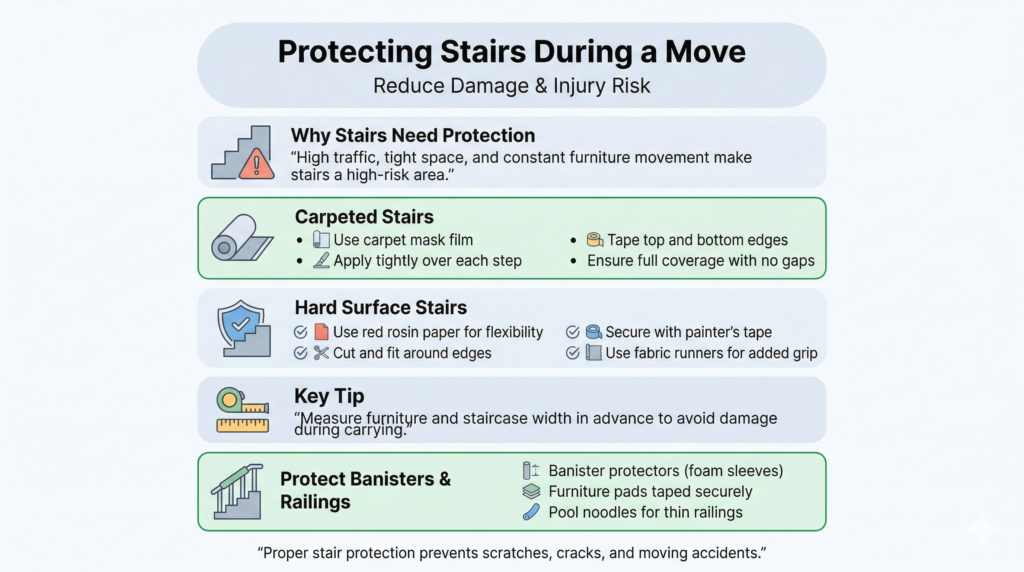
Stairs are one of the highest-risk zones on moving day. They see constant heavy foot traffic, every piece of furniture traveling between floors passes over them, and the tight space means furniture corners are almost guaranteed to brush against the surface. Taking a few minutes to measure and cover stairs properly prevents the most common type of moving damage.
Carpeted Stairs
For carpeted stairs, carpet mask film is the best covering option. It adheres lightly to the carpet surface, stays in place under foot traffic, and protects against staining and grit. Roll the film out tightly over each step and use painter’s tape at the top and bottom edge of the run to keep it from curling. Make sure every step is covered with no exposed gaps.
Hard Surface Stairs
Hard surface stairs, whether hardwood, tile, or stone, need a more flexible covering since step edges require custom fitting. Red rosin paper is the most practical choice because it is easy to cut, bends around step edges cleanly, and provides reliable scratch protection. Tape each piece down firmly with painter’s tape. Fabric runners are another option that conform naturally to each step and reduce slip risk while still protecting the surface.
| “Before we cover anything on stairs, we measure the furniture and the staircase width. Most stair damage comes from furniture that is too wide for the space, not from improper carrying technique. If you know the measurements ahead of time, you can plan the angle of carry and avoid the frame and wall entirely.”– James Tran, Lead Moving Coordinator, Midwest Relocation Specialists |
Protecting Banisters and Railings
Banisters and railings are easy to overlook because they sit at the edge of the staircase rather than underfoot. But a moving box corner swung into a banister can crack wood or strip a finish in seconds. Cover railings on all sides using one of these methods:
- Dedicated banister protectors: Purpose-built foam or padded sleeves that clip around the railing. The cleanest and easiest option.
- Furniture pads draped and taped: A folded furniture pad draped over the entire length of the banister and secured with painter’s tape works well. Make sure the pad extends all the way around the underside of the railing, not just the top.
- Pool noodles for thin railings: Some professional movers use foam pool noodles split lengthwise and taped around thinner railings. It looks unconventional but provides solid cushioning at low cost.
How Do You Protect Door Frames and Doorways?
Door frames are the single most frequently damaged area during a move. Every large item, every appliance, every piece of furniture has to pass through at least two of them, and the clearance is often just a few inches on each side. Protecting door frames is not optional if you want to avoid repair bills.
Padding Door Frames Without Specialized Products
You do not need to buy specialized gear to protect door frames. Materials you already have handle the job well:
- Moving blankets: Drape a moving blanket over the top of the door frame and let it hang down both sides. Secure with painter’s tape at the top corners. This protects the frame from the sides and the top, which are the three contact points for most furniture.
- Cardboard sheets: Cut flat pieces of cardboard and tape them along both vertical sides of the frame and across the top. Double the cardboard in the corner zones where the most impact happens.
- Bubble wrap: Add a layer of bubble wrap under the cardboard or blanket for extra cushioning in narrow doorways where furniture will definitely make contact.
- Foam door jamb protectors: If you can find these at a hardware store, they slip directly onto the door frame edges and are the cleanest, fastest solution. They protect from dings, dents, and scratches without any taping needed on the frame itself.
Whichever material you use, secure it with painter’s tape only. Never use duct tape or standard packing tape directly against painted door frame surfaces.
Should You Remove Doors Entirely?
For very narrow doorways or particularly wide pieces of furniture, removing the door from its hinges is sometimes the right call. Taking the door off gives you an extra inch or two of clearance on each side and removes the risk of damaging the door itself.
Set a bed sheet on the floor near the doorway before removing the door, so you have a clean surface to lay it flat. Wooden doors are heavier than they look, so have a helper ready. Do not attempt to remove a door if you are unsure how to do it safely. Use the padding techniques instead.
Protecting Walls and Corners Near Doorways
Walls near doorways, particularly drywall, are easy to damage with the corner of a moving box or the edge of a dresser. Install temporary corner guards on high-traffic wall corners before the move begins. For long hallway walls, tape sections of cardboard or foam board at furniture height along both sides. It does not need to look professional, it just needs to be there when something makes contact.
| “Corner guards are a five-minute install that saves a drywall repair that takes half a day. We put them on every exposed corner in the main path before we carry the first item. The cost is almost nothing compared to what patching and painting drywall costs a homeowner.”– Rachel Simmons, Senior Moving Consultant, Green Bay Home Services Network |
What Tools and Techniques Reduce Floor and Wall Damage?
The right equipment reduces the chance of damage before it happens. Using proper tools is just as important as laying down floor coverings.
Furniture Sliders and Dollies
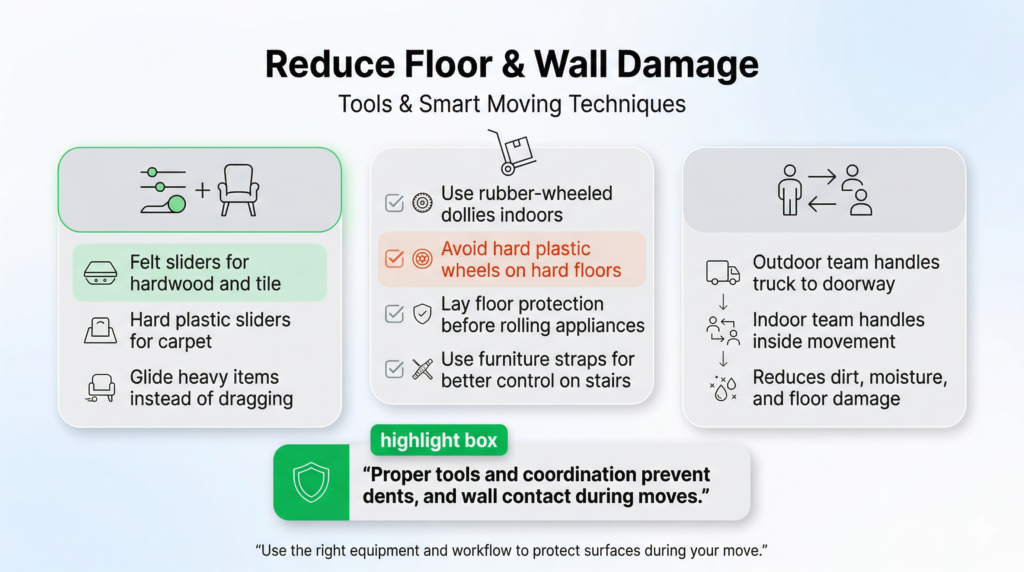
Furniture sliders attach to the bottom of chair legs and large furniture pieces. They let you glide heavy items across the floor with minimal friction rather than dragging them. Use felt sliders on hard surfaces like hardwood and tile, and hard plastic sliders on carpet.
For dollies, always choose rubber-wheeled dollies for interior use. Hard plastic wheels leave dents in hardwood and visible scratches across tile. For appliances, lay down a clear path of floor protection before rolling anything across the room. Furniture straps give two people far better grip and control on stairs, which means fewer awkward tilts and less contact with the wall and railing.
Splitting Your Crew Into Indoor and Outdoor Teams
One of the most effective and underused techniques is splitting your moving crew into two groups. The outdoor team stays outside the home and handles items between the truck and the doorway. The indoor team takes items from the doorway and carries them to their destination inside. This approach eliminates the back-and-forth of dirty outdoor shoes across your floors and cuts down significantly on the dirt and moisture tracked inside during a long moving day.
For more strategies to stay organized on moving day, see our moving day checklist and our complete moving checklists for Green Bay homeowners.
Quick Reference: Floor and Surface Protection Guide
Use this table to find the right protection product for each surface in your home before moving day.
| Surface Type | Best Product | Backup Option | Tape Type |
| Hardwood (prefinished) | Floor Shield or Ram Board | Red rosin paper | Painter’s tape |
| Hardwood (job-finished) | Builder’s paper or X-Board | Ram Board | Painter’s tape |
| Tile / Laminate | X-Board (high traffic) | Ram Board with dolly path | Painter’s tape |
| Carpet | Carpet mask film (adhesive) | Masonite boards | No tape on carpet |
| Carpeted Stairs | Carpet mask film | Moving blankets + tape | Painter’s tape |
| Hard Surface Stairs | Red rosin paper (flexible) | Fabric runner | Painter’s tape |
| Door Frames | Foam door jamb protectors | Moving blankets + cardboard | Painter’s tape |
| Banisters / Railings | Banister protectors | Furniture pads + tape | Painter’s tape |
For large, heavy, or awkward items like safes, pianos, and appliances, consider booking our specialty item moving services where our crew brings all protective materials and equipment as part of the job.
Do Professional Movers Protect Your Floors and Door Frames?
Most reputable moving companies arrive with a standard kit of protective materials. A professional crew typically brings moving blankets, Ram Board or Masonite, door jamb protectors, corner guards, and furniture sliders. Their experience loading and carrying also reduces the mistakes that lead to damage, like dragging furniture around corners or backing into door frames.
That said, not all movers treat floor protection with the same level of care. Before your move, ask your moving company directly what they bring and where they use it. Be specific, and ask about hardwood floors, carpeted stairs, and narrow doorways. If you have concerns about delicate surfaces, let them know in advance. Our team at Green Bay Moving Co. discusses surface protection as part of every pre-move conversation. For an overview of what our crew handles behind the scenes, see what happens behind the scenes with your favorite movers.
Moving blankets are one of the most versatile tools professional movers use. Learn more about why you really need moving blankets and how they protect both furniture and surfaces during a move.
| “A good moving crew spends the first fifteen minutes of every job laying protection before they touch a single item. That prep time is where most property damage is prevented. If your movers walk straight to the furniture without putting anything down first, that is a red flag worth paying attention to.”– David Okafor, Certified Moving Consultant, American Moving and Storage Association |
Ready to Move Without the Stress of Property Damage?
Protecting your floors, stairs, and door frames on moving day is one of the most practical things you can do to avoid expensive repairs and unnecessary stress. The steps are not complicated. Cover hard floors with the right product for your surface type. Use carpet film or rosin paper on stairs. Pad door frames on all sides before the first piece of furniture comes through. Secure everything with painter’s tape. Split your crew into indoor and outdoor teams.
If you would rather leave it all to people who do this every day, our packing tips and crew preparation resources are a great place to start planning. And when you are ready to book a move in Green Bay or the surrounding Wisconsin communities, the Green Bay Moving Co. crew brings the protection materials, the experience, and the care to make sure your home looks exactly the same after the move as it did before it.
Contact Green Bay Moving Co. LLC today for a free quote. Call us or visit greenbaymovingco.com to get started.