





Reserving your condo’s service elevator is one of the most important steps in planning a condo move. Most buildings require you to book the elevator 2 to 4 weeks in advance, during approved time windows that typically run Monday through Friday, 9 AM to 5 PM. Without a confirmed reservation, your movers may be denied access entirely, turning your moving day into a costly, stressful delay.
Key Takeaways
- Book the elevator 2 to 4 weeks in advance – popular buildings fill up fast, especially May through September.
- Most condo time windows run 2 to 4 hours – plan your packing schedule and mover arrival around that block.
- Your moving company needs a Certificate of Insurance (COI) – the building must be listed as additionally insured.
- Expect a refundable damage deposit of $200 to $500 – document the elevator and hallways with photos before and after.
- Fines for unauthorized moves range from $200 to $500 – plus potential rescheduling costs that add up fast.
- Midweek moves (Tuesday through Thursday) tend to have better elevator availability than Fridays or Mondays.
Why Condo Elevator Reservations Are Non-Negotiable
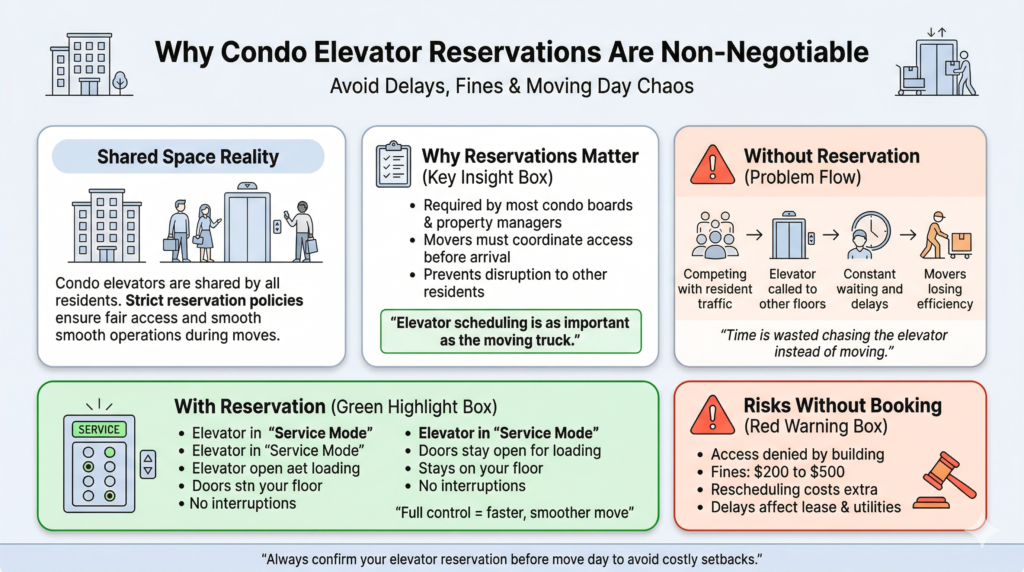
When you move into or out of a condo, you are operating inside a shared living environment. The elevator is not yours alone. Every other resident depends on it daily, which is exactly why most condo boards and property management companies enforce strict reservation policies to protect everyone.
According to FMCSA guidelines for residential moves, professional movers are expected to coordinate access logistics before arrival. Showing up to a building without a confirmed elevator reservation puts your entire move at risk.
“In high-rise moves, elevator scheduling is as important as the moving truck. Without it, you risk delays, fines, and unhappy neighbors.”
– Alex I., Senior Relocation Coordinator, A-Z Moving Condo Movers Division
How Competing for an Unreserved Elevator Slows Everything Down
Without a reserved elevator, your movers must compete with regular resident traffic throughout the building. Every time the elevator is called to another floor mid-load, your team loses time. Movers may end up spending as much time chasing the elevator up and down as they do carrying your belongings.
When a building puts an elevator into Individual Service mode for your move, the doors stay open as long as your crew needs them. The elevator stays on your floor and cannot be called elsewhere. Without that mode active, this level of control is simply not possible.
What Happens If You Show Up Without a Booking
Buildings can and do deny access to moving crews without confirmed reservations. Some buildings impose fines ranging from $200 to $500 for unauthorized moves, and emergency rescheduling with your moving company can cost hundreds more on top of that. If you are also managing lease start dates or utility setups, a failed moving day creates a chain of problems that extends well beyond the day itself.
How Far in Advance Should You Reserve the Elevator?
The standard recommendation from building managers and professional movers alike is to contact your property management office as soon as you confirm your move date. Waiting until the week of your move is one of the most common mistakes condo residents make.
Standard Lead Times by Building Type
Lead time requirements vary depending on your building’s size, management style, and demand. Here is a general breakdown:
| Building Type | Recommended Lead Time | Notes |
| Standard condo or apartment | 2 to 4 weeks | Minimum for most buildings |
| Luxury high-rise or doorman building | 4 to 6 weeks | Slots fill faster, more documentation required |
| Peak season (May to September) | 6+ weeks | Especially in high-demand urban areas |
| Off-peak weekday move | 1 to 2 weeks | More flexibility, but always confirm early |
Industry experts consistently recommend booking 2 to 4 weeks before your move date as the baseline. During peak moving season, a 6-week lead time is the safer choice for buildings in high-demand areas.
“For buildings in high-demand areas, a six-week lead time is safer. Confirm the reservation in writing with the building manager and ensure the reservation includes the loading dock space.”
– Moving logistics team, My Dad’s Moving Inc., San Jose, CA
Peak Moving Season Considerations
The busiest moving months across the United States run May through September, with the highest concentration of moves happening at the end of the month when leases typically turn over. During this window, elevator time slots in popular condo buildings can book out 3 to 4 weeks ahead, sometimes longer.
Midweek moves – specifically Tuesday through Thursday – tend to offer better elevator availability than Mondays or Fridays. Many buildings also restrict moving activity on Sundays and holidays, so confirm those restrictions before locking in your move date.
What Does a Typical Condo Elevator Booking Process Look Like?
Every building has slightly different procedures, but the core process follows a consistent pattern. Understanding it in advance prevents last-minute scrambling and ensures your movers can get to work as soon as they arrive.
Steps to Reserve the Service Elevator
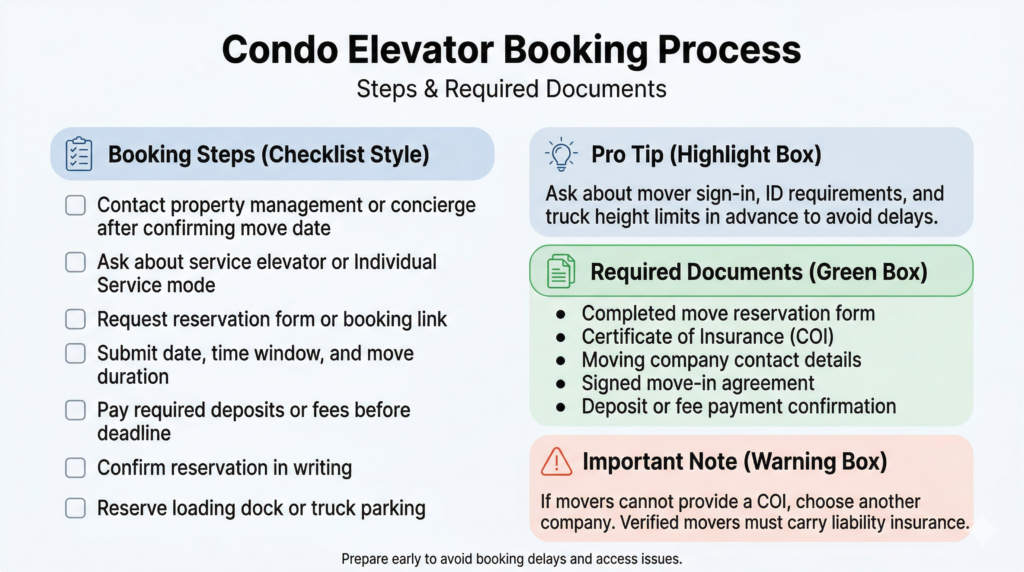
- Contact your property management office or concierge as soon as your move date is confirmed.
- Ask whether the building has a designated service elevator or uses Individual Service mode on the main elevator.
- Request the moving reservation form or online booking system link.
- Submit the form with your desired date, time window, and estimated move duration.
- Pay any required deposits or fees before the deadline the building sets, which is often one week prior to your move.
- Confirm the reservation in writing and keep a copy accessible on moving day.
- Reserve loading dock or designated truck parking at the same time – these often book separately.
Pro tip: Ask your building manager whether they require the movers to sign in and provide ID, or whether the loading dock has a height restriction for trucks. Passing this information to your moving company ahead of time prevents access delays at arrival.
Documents You Will Need Ready
Most managed condo buildings require a short list of documents before they will confirm your elevator reservation. Gather these early so nothing stalls your booking.
- Completed move reservation form – provided by property management or your building’s concierge
- Certificate of Insurance (COI) – from your moving company, naming the building as additionally insured
- Moving company contact details – name, license number, and phone number of the crew lead
- Signed building move-in agreement – some condos require this as a separate form
- Deposit or fee payment confirmation – keep the receipt in case of any disputes after the move
“If your movers can’t provide a COI, find someone else. Every legitimate professional moving company carries liability insurance and can produce that document within a few business days.”
– Moving Operations Team, Avant-Garde Moving, New York City
Understanding Condo Moving Time Windows
A moving time window, also called a time block or reservation slot, is the specific period during which you have exclusive or priority access to the service elevator. Understanding how these windows work helps you plan your packing schedule, mover arrival time, and overall move-day logistics accurately.
Common Allowed Hours and Day Restrictions
Most condo and apartment buildings across the United States follow a fairly standard set of moving hour policies, though exact rules vary by property. Here is what to expect:
| Policy Area | Typical Rules |
| Allowed days | Monday through Friday; some buildings permit Saturday |
| Moving hours | 9:00 AM to 5:00 PM or 9:00 AM to 4:00 PM |
| Elevator time block length | 2 to 4 hours per booking |
| Sunday and holiday moves | Typically prohibited to protect residents |
| After-hours moves | Possible at some buildings for an additional fee |
Some luxury buildings charge an extra staffing fee for after-hours elevator access, typically ranging from $100 to $400 depending on building policy. If your schedule only allows for an evening or weekend move, check with your building manager about what after-hours options exist before assuming it is not possible.
How to Plan Your Move Around the Time Block
Your elevator time window is fixed once confirmed. This means your packing, loading, and mover arrival all need to align with that block. Here is a practical approach:
- Book your movers for 30 minutes before the elevator window opens – this gives the crew time to arrive, check in, and set up protective padding before the clock starts.
- Prioritize heavy and bulky items for elevator transport – if your window runs short, smaller boxes can go by stairwell.
- Pre-stage boxes near the unit door the night before – reducing in-unit carry time helps your crew work faster inside the window.
- Confirm truck parking before moving day – a crew that spends 30 minutes finding legal parking is time you are paying for.
- Build 30 minutes of buffer into your time estimate – hallway congestion, elevator padding setup, and building check-in add time you may not account for.
“The elevator is the real schedule on a condo move. If we don’t have it reserved, your move time and cost can double because we’re competing with residents for access.”
– Moving Operations, United Prime Van Lines, Miami, FL
Fees, Deposits, and Insurance Requirements Explained
Most condo buildings charge some combination of fees and deposits associated with elevator reservations and moving access. Knowing what to expect helps you budget accurately and avoid surprise deductions after your move.
Refundable Damage Deposits vs. Non-Refundable Move Fees
These are two distinct charges that often get confused. Understanding the difference matters both for budgeting and for protecting your deposit.
| Charge Type | Typical Range | Refundable? | What It Covers |
| Damage deposit | $200 to $500 | Yes, if no damage | Potential damage to elevator, hallways, lobby floors |
| Non-refundable move fee | $100 to $300 | No | Elevator padding setup, staff time, extra electricity |
| After-hours access fee | $100 to $400 | No | Building staff costs for evening or weekend moves |
Always photograph the elevator interior, hallways, and lobby floors before your movers begin carrying anything. Do the same walk-through after the move. If the building later claims damage, your timestamped photos are your primary evidence. Many buildings deduct from deposits for even minor scuffs, and the burden of proof falls on the resident.
What Is a Certificate of Insurance and Why Your Building Needs One
A Certificate of Insurance (COI) is a one-page document issued by your moving company’s insurance provider that confirms they carry active liability coverage. Your condo building requires it to protect the property in case of accidental damage to shared spaces during the move.
Specifically, the COI must confirm three things:
- General liability coverage – usually $1 million to $2 million minimum for standard buildings; luxury high-rises may require up to $5 million
- Workers’ compensation insurance – covering the moving crew in case of injury on the property
- The building listed as additionally insured – this is the critical line; without it, many buildings will reject the COI entirely
Submit the COI to your property management office at least 48 to 72 hours before your move date. Most reputable moving companies, including Green Bay Moving Co., can provide a COI within a few business days of being given the building’s legal name and mailing address.
“Failure to provide an accurate, up-to-date COI results in immediate denial of building access. The building manager requires the property owner and the management firm to be listed as additionally insured.”
– Logistics Team, My Dad’s Moving Inc., San Francisco Bay Area
Tips for a Smooth Elevator Move with Professional Movers
Having your documentation and booking confirmed is the foundation. These practical steps help make sure the actual moving day runs without a hitch.
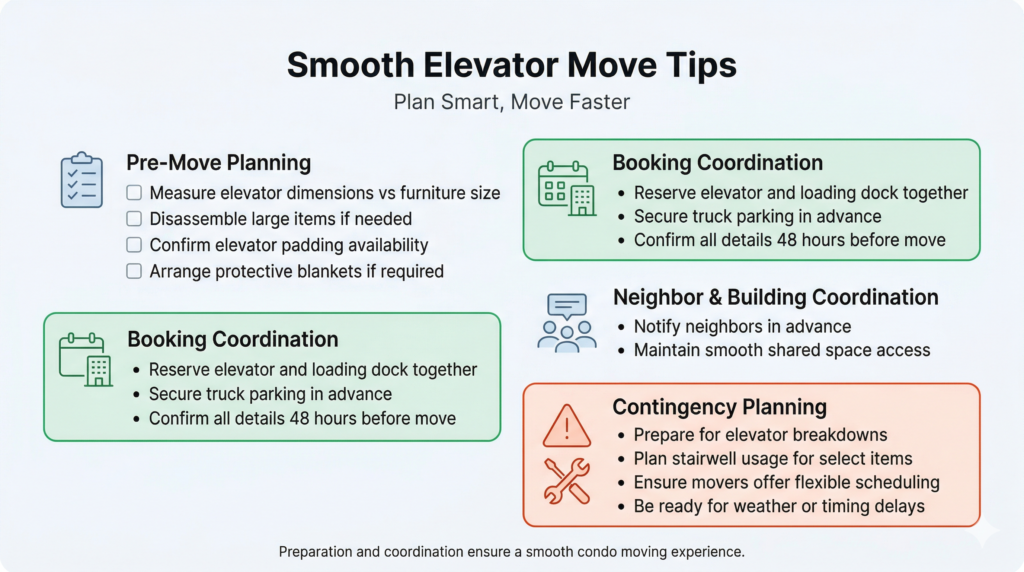
- Measure your elevator before booking your move date. Check interior dimensions against your largest furniture pieces. An armoire or sectional sofa that cannot fit vertically may need to be disassembled or use the stairwell.
- Ask if the building provides protective elevator pads or if your movers should bring their own. Some buildings hang specialized moving blankets as part of their elevator reservation service; others expect your crew to supply them.
- Reserve loading dock or designated parking at the same time as the elevator. These reservations are often separate and limited – booking one without the other creates access problems on moving day.
- Notify immediate neighbors in advance, even if the building does not require it. A quick note or message goes a long way toward maintaining goodwill in your new building.
- Confirm all reservation details 48 hours before the move. Call or email building management to verify the time window, elevator status, and truck parking arrangements are still active and correct.
- Have contingency plans ready. Elevator breakdowns, scheduling conflicts, and weather delays can all disrupt even a well-planned condo move. Know which items can go by stairwell and confirm your moving company has flexible scheduling options.
If you are still working through your full moving preparation, our complete moving checklist covers every stage from packing to move-in day. Condo residents will also find our apartment moving checklist for Green Bay and Allouez especially useful for managing building-specific logistics.
Ready to Move Into Your Condo the Right Way?
Elevator reservations and condo moving logistics involve more planning than a standard residential move, but none of it is complicated when you start early. Book your elevator 2 to 4 weeks out, confirm your moving time window, gather your COI and paperwork, and document the common areas before and after. Handle those steps and your move-in day stays on schedule and within budget.
Still working through your full moving plan? Check out our moving day prep checklist for a complete timeline, or browse our local guides for Wisconsin families for building-specific advice across the Green Bay area.
Green Bay Moving Co. is a licensed and insured moving company serving Green Bay, Appleton, De Pere, Allouez, Ashwaubenon, Howard, Suamico, and surrounding Wisconsin communities. We coordinate directly with building management, provide COI documentation, and handle elevator logistics so you can focus on settling into your new home. Get your free quote today and let our crew take the stress off your shoulders.
Frequently Asked Questions About Condo Elevator Reservations
Can I move into a condo without reserving the elevator?
Technically possible in buildings without formal systems, but risky. Most managed condo buildings require a reservation, and showing up without one can result in denied access, fines, or being forced to reschedule. Even in buildings with informal arrangements, coordinating with your concierge in advance ensures the elevator is available when you need it.
What if someone else has the elevator booked right before or after my window?
This is one of the trickier scenarios in a condo move. If the previous resident overruns their slot, your window shrinks. Communicate clearly with building management so they can enforce time limits. If your move ends up running over, your movers will need to wait until the next available slot, which adds cost. Building a 30-minute buffer into your own time estimate reduces this risk.
Do my movers handle the COI paperwork, or is that my responsibility?
Your moving company provides the COI; your job is to give them the building’s legal name and address and confirm what coverage limits your building requires. You are then responsible for submitting the document to building management before the deadline. Our team at Green Bay Moving Co. handles COI documentation as a standard part of every condo and apartment move.
How do I know if my building has a service elevator or uses Individual Service mode?
Ask your property management office or concierge directly. Service elevators are dedicated freight lifts, common in larger buildings, often accessible via a separate loading entrance. Individual Service mode is a setting applied to standard passenger elevators that locks them to one floor during your move. Both accomplish the same goal: your crew gets exclusive access for the duration of your reserved window.